Two Is the New Twenty: Why the One-on-One Hangout Is Having Its Biggest Moment Yet
There's a specific kind of exhaustion that comes from being in seventeen group chats and still feeling like nobody actually knows you. You've sent the memes, reacted to the announcements, dropped the occasional "lmaooo" — and yet. Something's missing.
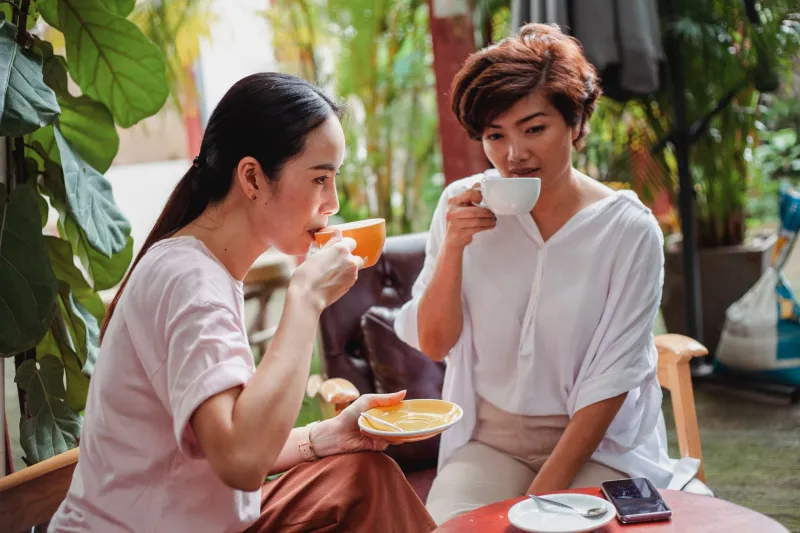
Gen Z figured this out before anyone put a name to it. Quietly, without a big announcement or a trend piece to kick it off, the one-on-one coffee date started making a serious comeback. Not brunch for eight. Not a birthday kickback where you shout over music all night. Just two people, a table, and an actual conversation that goes somewhere real.
This is the slow social — and it might be the most culturally interesting shift happening in friendship right now.
The Group Chat Isn't Going Anywhere — But It's Not Enough Either
Let's be clear: nobody's deleting their group chats. They still serve a purpose. Coordinating plans, sharing links, keeping up with the crew in a low-stakes way — that's all fine. But there's a growing awareness that group chat activity and genuine connection are two very different things.
When you're always talking to everyone, you're kind of talking to no one. The dynamic shifts. You perform a little more. You think about how the joke lands with the group instead of just saying what you actually mean. It's social, but it's also kind of a show.
The one-on-one cuts all of that out. There's no audience. No one to play to. Just the two of you, which means the conversation either goes somewhere real or it becomes obvious pretty quickly that it won't.
That honesty? That's exactly what people are craving.
Coffee as a Cultural Statement
It's not an accident that coffee is the default setting for this kind of hangout. Coffee shops occupy a specific cultural space in the US right now — they're public enough to feel low-pressure, but intimate enough for a real talk. You're not locked into a three-hour dinner. You're not stuck at a party trying to find a quiet corner. You show up, you order something, you sit down.
The format itself signals something: I want to actually talk to you. Not just exist near you at a larger event. Not just double-tap your posts. Talk to you.
And there's something about the ritual of it — the ordering, the finding a spot, the settling in — that creates a container for the conversation. It has a beginning and an end. It's intentional without being heavy.
For a generation that grew up with infinite scroll and no natural stopping points, that kind of built-in structure is actually kind of a relief.
Depth Over Volume
Here's the thing about having 400 followers who casually know you versus three people who really know you: only one of those actually helps when something goes sideways in your life.
Gen Z has had a front-row seat to the limits of wide, shallow connection. They watched social media promise community and deliver comparison. They watched follower counts go up while loneliness statistics followed right behind them. They've done the math.
The conclusion a lot of people are landing on is simple: depth beats volume. Every time.
A friendship where someone remembers what you said six months ago, checks in because they actually thought about you, and shows up when it's inconvenient — that's worth more than any number of group chat reactions. And the only way to build that kind of friendship is through time spent one-on-one, without the noise.
The Logistics of Slowing Down
One of the underrated challenges of the one-on-one hangout is that it actually requires effort. You have to reach out to a specific person, land on a time that works for both of you, and show up. There's no hiding in the crowd. If you bail, it's just you bailing on one person — which feels different than going quiet in a group chat.
That accountability, though, is kind of the point. It raises the stakes just enough to make it feel meaningful.
People are also getting more intentional about who they're investing that time in. The era of saying yes to every hangout out of FOMO or social obligation is fading. In its place, there's a more deliberate approach: who do I actually want to know better? Who do I leave feeling energized instead of drained? Who am I curious about?
Those questions used to feel almost too serious to ask about friendship. Now they feel like basic self-awareness.
What This Looks Like in Real Life
It's the coworker you grab coffee with on a random Tuesday, not because anything happened, just because you wanted to catch up for real. It's the friend from college you've been meaning to call who you finally text: hey, are you free Saturday morning? It's the person you've been circling in a mutual friend group who you finally just ask directly.
These are small moves. But they accumulate into something. A friendship that has its own history, its own inside references, its own rhythm. Something that exists outside of the group context and can survive without it.
That kind of friendship is increasingly rare — which is exactly why it feels so valuable.
The Vibe Is Intentional
What makes the slow social feel so culturally significant isn't just that it's a reaction to digital overload. It's that it represents a genuine shift in what people consider a good use of their time and social energy.
Showing up for someone, one-on-one, with your full attention — no phone face-down between you, no half-distracted scrolling — is starting to feel like a real flex. Not in a performative way. In a this is how I choose to spend my time way.
And for a generation that's been told connection is just a tap away, discovering that the best version of it requires actually sitting across from someone? That's not a step backward. That's a pretty sophisticated conclusion to reach.
Grab the coffee. Make the plan. Show up. It turns out that's still how it works.